Project Demo
Demonstration video of the automation workflows.
Architecture at a Glance
n8n coordinates the complete lifecycle across voice, CRM, memory, scheduling, communication and AI extraction.
Executive Summary
Capture Now 360 uses an end-to-end AI calling automation platform for inbound and outbound sales. n8n acts as the orchestration layer, Vapi handles real-time voice conversations, Monday.com is the sales CRM, PostgreSQL provides long-term conversation memory, Google Calendar/Meet handles discovery-call scheduling, SMTP delivers follow-ups, and OpenAI extracts natural-language meeting dates and times into structured data.
Business Context
The system is designed around Capture Now 360’s virtual-tour, digital-twin and Matterport-style sales motion. The AI agent “Blake” handles first-line sales conversations, qualification, follow-up and discovery-call scheduling. The documented objectives are to scale outbound outreach, respond quickly to inbound calls, maintain consistent qualification and messaging, keep CRM data accurate, and remove manual calendar-booking work.
Core Capabilities
- Inbound AI call handling and caller identification
- Outbound AI campaigns with eligibility filtering and retries
- Context-aware conversations using prior call history
- Lead qualification and outcome classification
- Multi-phone-number handling
- Automated follow-up and industry-specific messaging
- Meeting-intent detection and natural-language date/time extraction
- Google Calendar availability checks and Google Meet creation
- Automatic CRM updates with summaries, transcripts and meeting links
- Persistent PostgreSQL conversation history and audit trail
Solution Architecture
The architecture is modular. n8n connects triggers, business rules, API calls, branching, batching and retries. Vapi owns live voice conversations, transcripts, recordings, summaries and voicemail handling. Monday.com owns sales-facing lead state. PostgreSQL stores historical conversation artifacts. Google Calendar is the time source for meetings, while SMTP owns human-readable confirmations and follow-ups. OpenAI converts natural-language scheduling phrases into structured datetime data.
High-Level Data Flow
Inbound call or outbound schedule → n8n orchestration → Monday.com CRM lookup → PostgreSQL history fetch → Vapi call handling → OpenAI analysis/extraction when required → PostgreSQL persistence → Monday.com update → Google Calendar/Meet scheduling when required → SMTP confirmation/follow-up.
Inbound Workflow — Detailed
10. If a meeting is requested, the scheduling branch checks availability, creates the event/Meet link, sends confirmation and pushes links back to Monday.com. 11. If no meeting is booked, an industry-aware follow-up can be sent.
- Vapi sends inbound call events to an n8n webhook.
- n8n extracts the caller’s phone number and prepares the call context.
- PostgreSQL retrieves the most recent conversation history.
- Historical summaries/transcripts are formatted into AI-readable memory.
- Monday.com is searched using normalized phone information.
- The workflow determines whether the caller already exists.
- n8n waits for Vapi to finalize the call, then fetches the final call artifact.
- Transcript, summary, recording, duration and meeting signals are extracted.
- The call is stored in PostgreSQL and the CRM is updated.
Outbound Workflow — Detailed
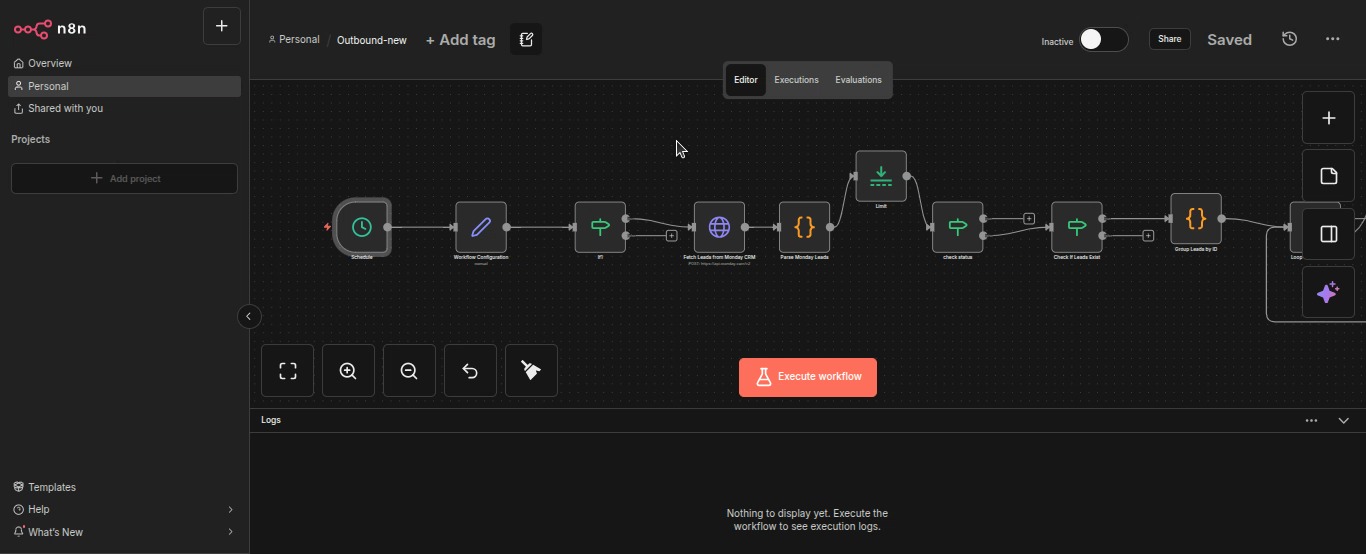
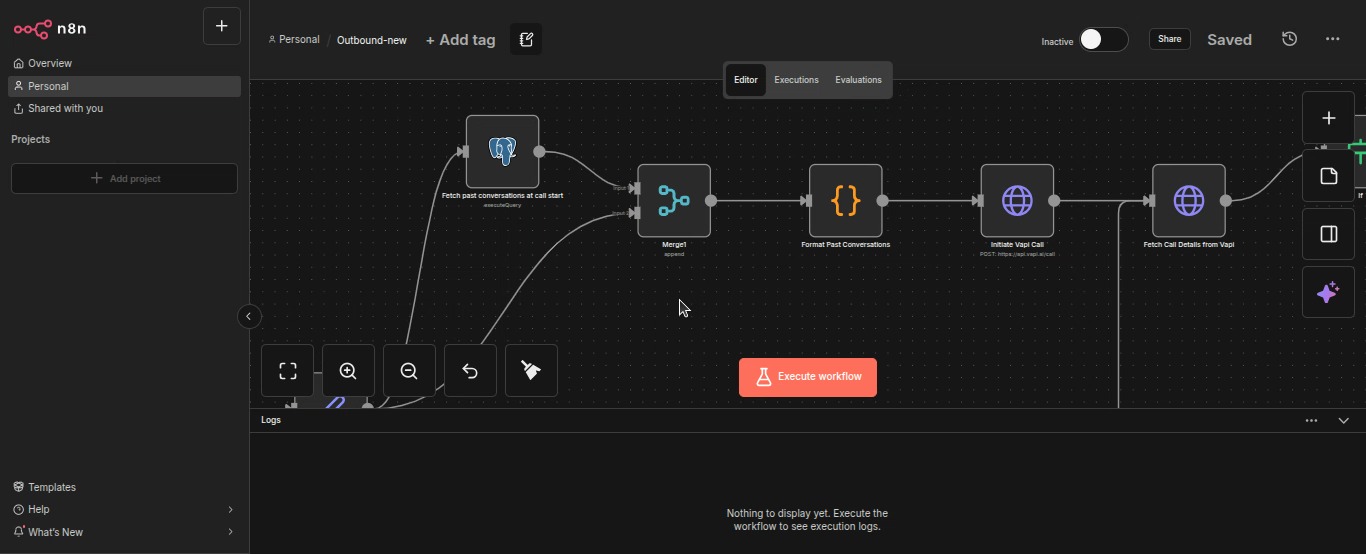
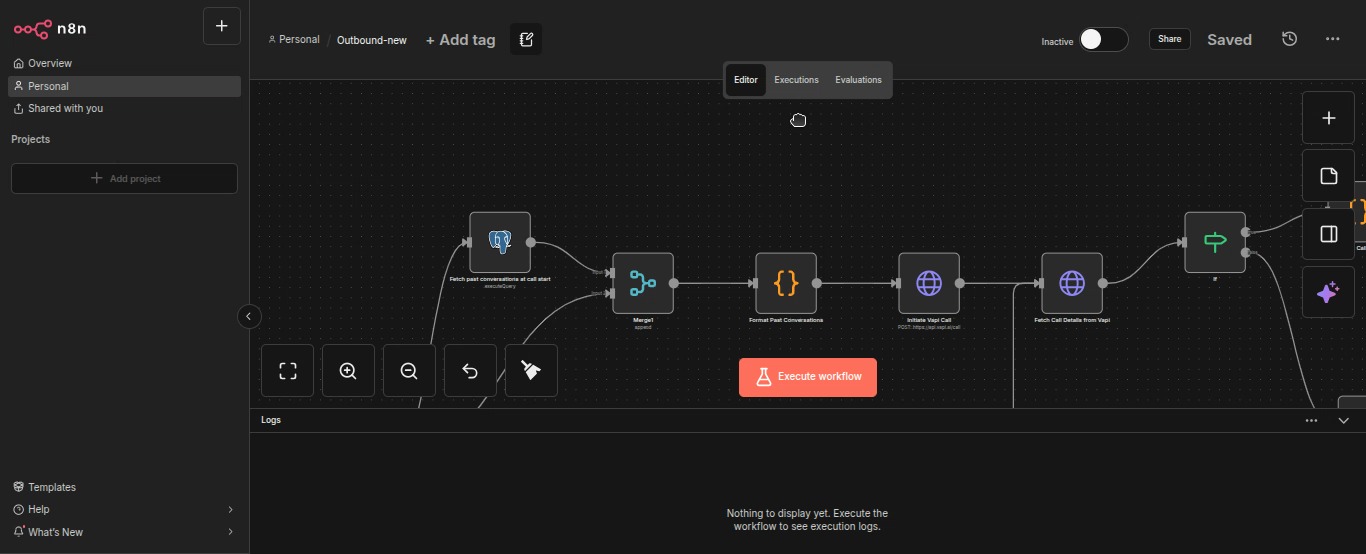
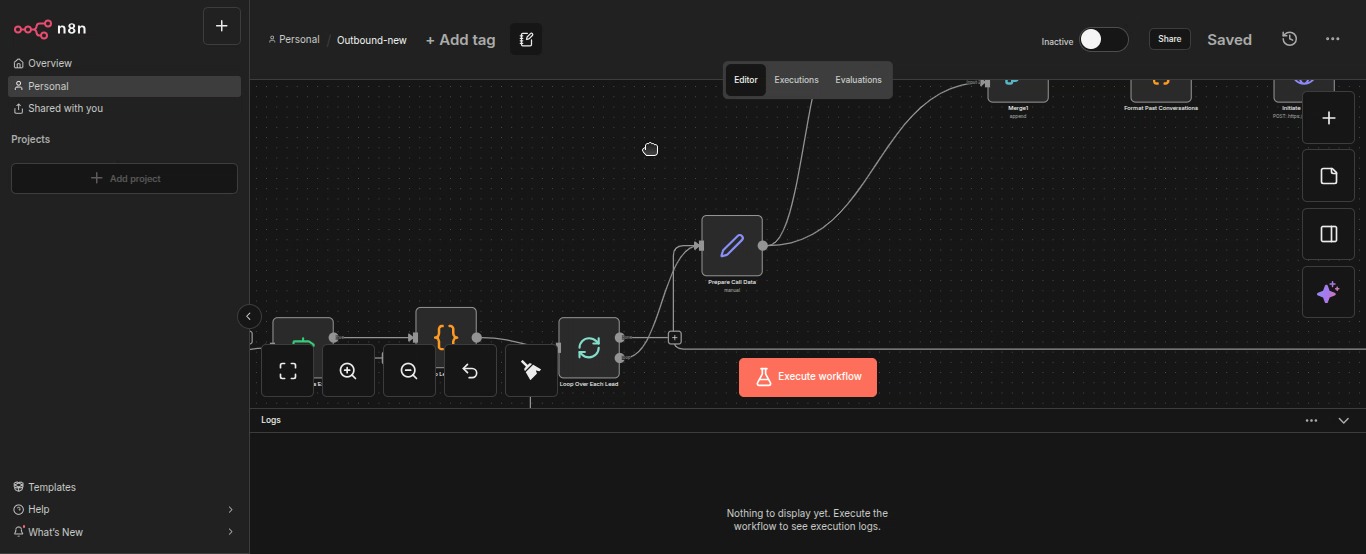
The outbound workflow runs from a daily schedule documented at 11:00 AM. It fetches eligible leads from Monday.com, validates lead fields and phone numbers, caps each run at 20 leads, groups alternate phone numbers, and processes leads one at a time. Before calling, PostgreSQL history is retrieved and injected into Vapi context. After the call, the workflow fetches final Vapi artifacts, extracts qualification/intent/objections/next steps, advances the lead status, stores the interaction, schedules meetings when appropriate, sends follow-up email and updates Monday.com.
AI Conversation & Personalization
The documented outbound conversation structure is: personalized introduction → discovery of needs and pain points → qualification → scheduling when interested → closing and next steps. Vapi receives variables such as first name, company, industry and formatted past conversations. This enables the assistant to continue conversations with context instead of treating every call as a blank interaction.
Persistent AI Memory
PostgreSQL is the long-term conversational memory and audit layer. The documented conversation_messages model stores fields such as phone number, lead identity, company, industry, transcript, summary, recording URL, timestamps, call duration, status/outcome, Vapi call ID, Monday item/board identifiers and meeting metadata. The AI context normally uses the last five conversations, providing continuity while keeping the prompt context bounded.
Lead Lifecycle & Qualification
Outbound dialing is restricted to an allow-list of statuses such as New Lead, Contacted and Attempted to Contact 1/2/3. Qualified and Unqualified leads are excluded. The no-answer ladder progresses through Attempted to Contact 1 → 2 → 3 → Unqualified. A positive path can progress New Lead → Contacted → Qualified, while a hard rejection can move directly to Unqualified. Alternate phone numbers are treated as part of the attempt process.
Meeting Automation
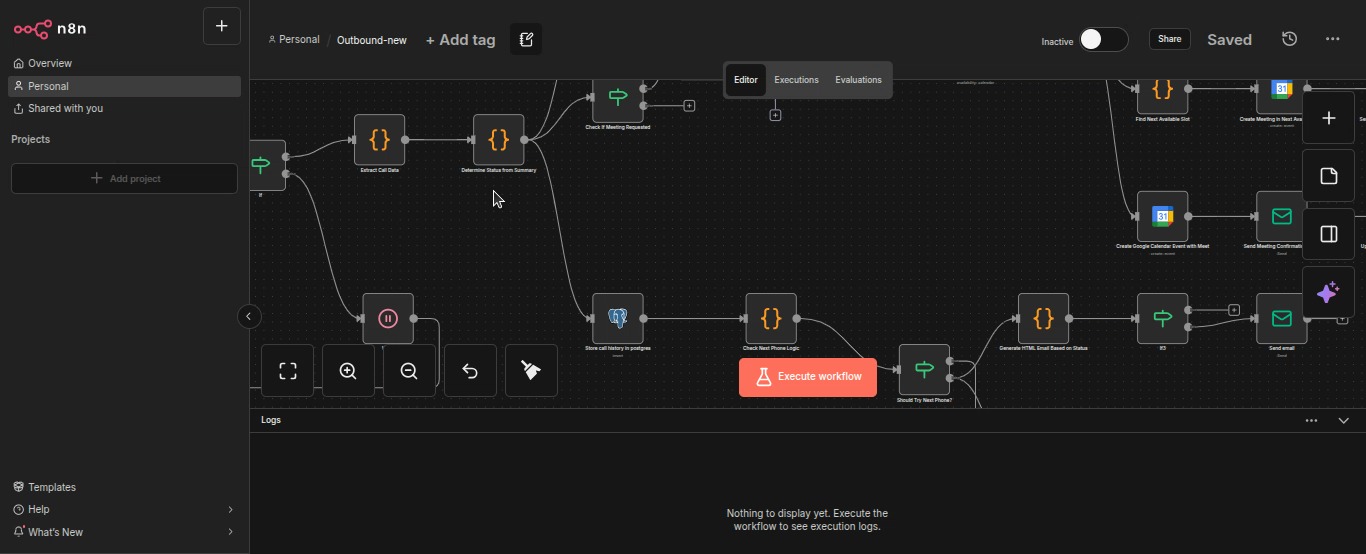
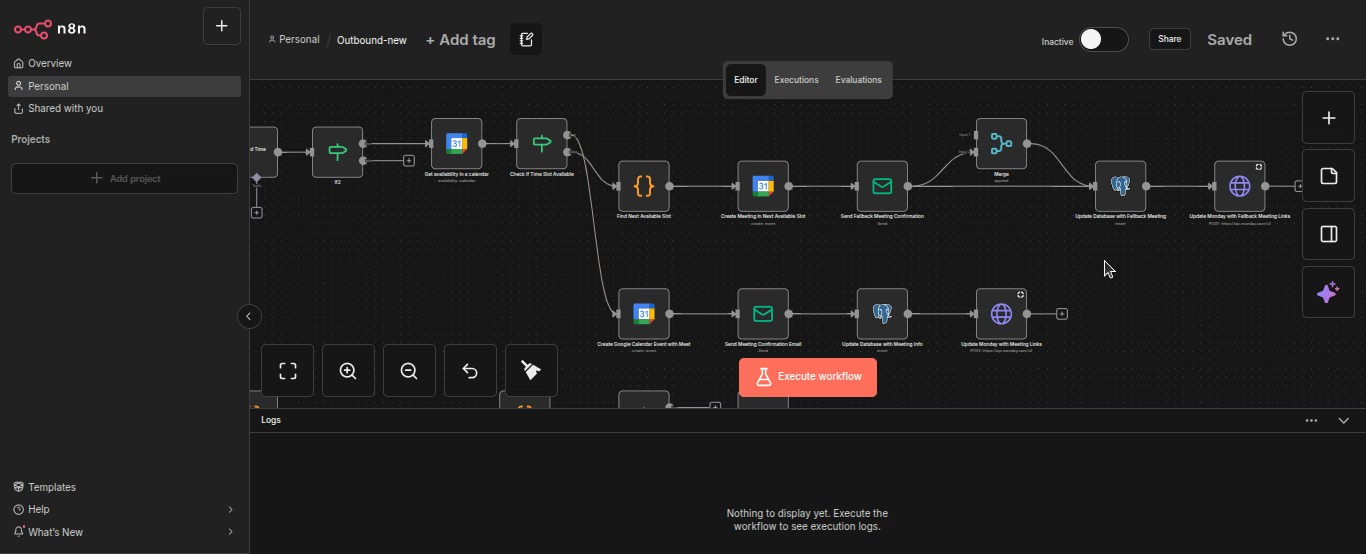
Both inbound and outbound flows share a meeting scheduler. Meeting intent can be detected through Vapi assistant variables and transcript parsing. OpenAI extracts natural-language time expressions such as “tomorrow 2pm” or “Friday morning”. Google Calendar availability is then checked. If the requested slot is free, a 30-minute meeting is created with Google Meet. If unavailable, the documented fallback searches weekday business hours, 9 AM–5 PM Pacific Time, for the next available slot. Confirmation details are emailed and stored in the CRM.
Email Automation
The system supports meeting confirmations and status/industry-specific follow-ups. Meeting emails include the scheduled time, Google Meet URL and Calendar link. Outbound follow-ups vary by qualification and attempt number and can be tailored to Commercial Real Estate, Construction, Hospitality or a default category. The documentation also defines separate messaging for first, second and final attempts.
CRM Automation
Monday.com acts as the sales-facing source of truth. The system identifies leads using normalized phone information, reads lead/company/industry/status fields, and writes back call summaries, transcripts, qualification status, attempt counts, AI notes and meeting links. GraphQL operations are used for board queries and mutations, with documented column IDs that should be revalidated whenever the live board structure changes.
Reliability Engineering
The workflows use continue-on-fail patterns on many HTTP nodes, wait nodes to allow Vapi processing to finish, IF/Switch branching for lead existence and meeting conditions, and one-at-a-time outbound processing to reduce race conditions. The outbound 20-lead cap is documented as an operational control for call duration, API rate limits and daily reviewability.
Security & Environment Strategy
The KT recommends keeping secrets in n8n Credentials and/or environment variables rather than hard-coding them. Separate Dev, Staging and Prod configuration sets are recommended. Additional hardening includes webhook verification/shared secrets, IP allowlisting where possible, API-rate-limit awareness, least-privilege database roles and workflow-failure audit logging. Historical exports containing credentials or live identifiers should be rotated and not copied into portfolio material.
Monitoring & Maintenance
Operational monitoring covers Vapi call starts and transcript delays; Monday.com authentication, GraphQL errors and rate limits; PostgreSQL connectivity and missing rows; Google OAuth token expiry; SMTP bounces/authentication; and n8n workflow errors, timeouts, stuck waits and missed schedules. Routine operations include reviewing daily outbound results, weekly spot checks between PostgreSQL and CRM notes, and revalidation after board-schema or assistant-prompt changes.
Troubleshooting Coverage
The documented troubleshooting matrix covers no leads processed, calls not initiating, emails not sending, incorrect industry templates, meetings not being created, CRM updates failing, missing conversation memory, inbound webhooks not firing, and workflows stopping mid-loop. Each issue is tied to concrete checks such as credentials, IDs, status filters, phone normalization, OAuth, webhook configuration and wait/rate-limit settings.
Technology Stack
n8n • JavaScript • Vapi AI • Monday.com GraphQL API • PostgreSQL • Google Calendar API • Google Meet • SMTP • OpenAI • Webhooks • HTTP Request nodes.
Operational Reference
Documented operating parameters include: outbound schedule 11:00 AM daily; maximum 20 leads per run; outbound batch size 1; approximately 5–10 seconds outbound wait; approximately 7 seconds inbound wait; last five conversations used for AI history; 30-minute meeting duration; Pacific Time scheduling; and fallback business hours of 9 AM–5 PM on weekdays. These are documented configuration values and should be confirmed against the live environment before changes.
Business Value
The documented business benefits are scalable outreach without proportional headcount, faster first response on inbound, consistent qualification and messaging, automatic CRM accuracy and auditability, persistent conversation context, and removal of manual discovery-call booking.
Workflow Screenshots
Selected frames from the supplied workflow demonstration.